15 September 2026
Study Time Calculator for A Level and O Level Students: Plan Your Study Time the Smart Way
Learn how to estimate and divide your available study hours effectively across A Level and O Level subjects using a simple study time formula and structured prep plan.
Premium student notes are available in PDF format. Login is required to download.
Preparing for **A Level or O Level exams** is not simply about studying for long hours. What matters more is knowing **how much time you actually have, how much syllabus remains, and how you should divide your study time between subjects**.
Many students sit at their desk for several hours but still feel unprepared. The problem is often not a lack of effort—it is a lack of a clear study plan.
That is where a **Study Time Calculator** can help.
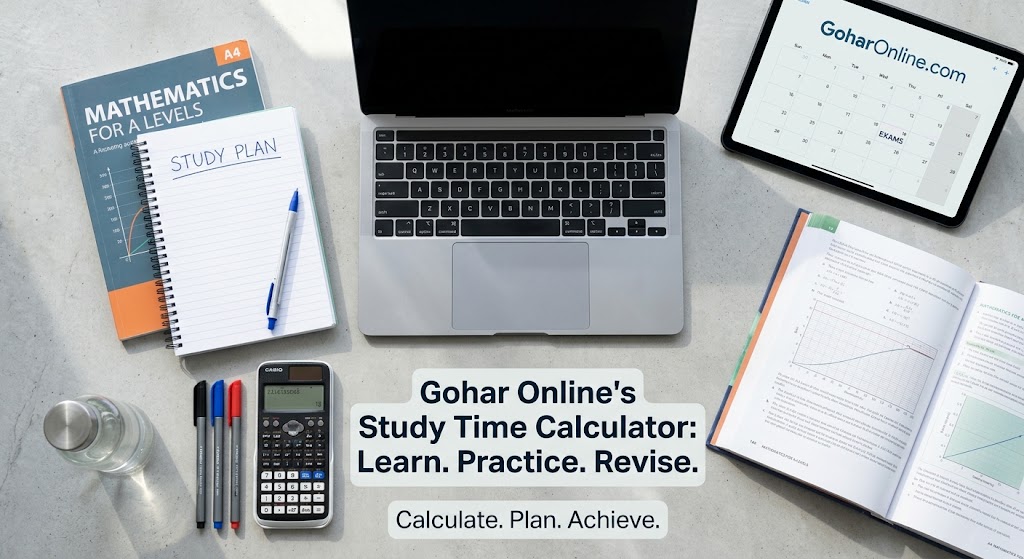
Our Study Time Calculator at **Gohar Online** helps students estimate how much study time they can dedicate to their subjects and organize their available hours more effectively.
## What Is a Study Time Calculator?
A Study Time Calculator is a simple planning tool that helps students estimate and organize their available study hours.
Instead of asking:
> "How many hours should I study today?"
you can start asking more useful questions:
* How many days are left before my exam? * How many hours can I study each day? * How much time should I give to each subject? * Which subjects need more revision? * How much time should I reserve for past papers? * Am I spending enough time on difficult topics?
For **O Level and A Level students**, this type of planning can make exam preparation more organized and less stressful.
## Why A Level and O Level Students Need a Study Plan
A Level and O Level courses can contain a large amount of material. Students may have several subjects, assignments, practical preparation, revision, and past papers to manage at the same time.
Without a plan, students often make one of two mistakes.
### Studying Too Little
A student may postpone difficult chapters and eventually discover that there is not enough time before the examination.
### Studying Without Priorities
Another student may spend many hours on one favorite subject while giving too little attention to subjects that require more practice.
A good study plan helps you distribute your available time according to your actual needs.
## How the Study Time Calculator Can Help
The **Gohar Online Study Time Calculator** can be used as a starting point for building your personal study schedule.
You can consider factors such as:
* Number of days available * Daily study hours * Number of subjects * Subject difficulty * Revision requirements * Past-paper practice * Breaks and rest periods
For example, suppose you have **30 days** before your exams and can realistically study **4 hours per day**.
Your total available study time would be:
**30 × 4 = 120 hours**
Instead of studying randomly, you can divide those 120 hours between your subjects.
The important point is that **120 planned hours are generally more useful than 120 unplanned hours**.
## How Many Hours Should an A Level Student Study?
There is no single number of study hours that is correct for every A Level student.
Your ideal study time depends on:
* Your current academic level * Number of subjects * Difficulty of your subjects * Time remaining before exams * Your school or college schedule * Homework and assignments * How quickly you understand new topics
Rather than copying another student's schedule, calculate how much time you realistically have.
For example:
**School/college:** 7 hours **Travel and other responsibilities:** 2 hours **Sleep:** 8 hours **Meals and personal time:** 3 hours
The remaining time can then be divided between homework, revision, practice and relaxation.
The goal is not to study every available minute. The goal is to make your **available study time productive**.
## How Many Hours Should an O Level Student Study?
O Level students also benefit from a balanced timetable.
You may have subjects such as:
* Mathematics * Physics * Chemistry * Biology * Computer Science * English * Pakistan Studies * Islamic Studies * Other elective subjects
Each subject may require a different type of preparation.
For example, Mathematics and Physics often require regular problem-solving practice, while subjects involving more theory may require reading, active recall and revision.
Therefore, your timetable should not simply divide your study hours equally between every subject.
## Don't Divide Your Time Equally Between Subjects
One of the most common study-planning mistakes is giving every subject exactly the same amount of time.
Imagine you have three subjects:
| Subject | Current Level | Suggested Priority | | ---------------- | ------------- | ------------------ | | Mathematics | Weak | High | | Computer Science | Average | Medium | | English | Strong | Lower |
A better strategy would be to spend more time improving Mathematics while maintaining your performance in the other subjects.
Your study time should reflect your **needs**, not just the number of subjects you have.
## Use the 3-Step Study Time Method
After calculating your available study hours, divide your preparation into three major stages.
### 1. Learn
Use your first study sessions to understand the syllabus and difficult concepts.
Do not simply memorize information that you do not understand.
### 2. Practice
After learning a topic, solve questions.
For A Level and O Level students, practice is especially important because examinations require students to apply what they have learned.
### 3. Revise
Use revision sessions to identify weak areas and reinforce important concepts.
As exams approach, increase the amount of time dedicated to **past papers and timed practice**.
## Don't Forget Past Papers
A study timetable should include dedicated time for past papers.
Past papers can help you understand:
* Question patterns * Mark allocation * Time management * Frequently tested topics * Your weak areas * How to structure answers
Instead of waiting until the final few days, gradually introduce past-paper practice into your schedule.
For example:
**Early preparation:** Learn concepts **Middle preparation:** Topic questions + selected past-paper questions **Final preparation:** Full timed papers + revision
## Take Breaks While Studying
More study hours do not automatically mean better results.
If you study continuously for several hours without a break, your concentration may decrease.
Try dividing a long study session into smaller focused blocks.
For example:
**50 minutes study → 10 minutes break**
You can adjust the timing according to your concentration level.
During breaks, avoid activities that are likely to turn a 10-minute break into an hour of scrolling.
## Create a Weekly Study Target
Daily goals are useful, but weekly targets can give you a better picture of your progress.
For example:
**Monday:** Mathematics – Algebra **Tuesday:** Physics – Electricity **Wednesday:** Computer Science – Programming **Thursday:** Mathematics – Past-paper questions **Friday:** Physics – Revision **Saturday:** Computer Science – Programming practice **Sunday:** Weekly revision + test
At the end of the week, ask yourself:
**What did I complete?**
If you did not achieve your target, adjust the following week's plan instead of giving up.
## How to Calculate Your Total Study Time
You can use this simple formula:
**Total Study Time = Number of Study Days × Effective Study Hours Per Day**
For example:
**25 days × 4 hours = 100 study hours**
Now divide those hours according to your priorities.
If Mathematics needs 40% of your available preparation time:
**100 × 40% = 40 hours**
You could then allocate approximately 40 hours to Mathematics and divide the remaining time between your other subjects.
This is much more practical than simply deciding to "study harder."
## A Simple Study Time Example
Suppose an A Level student has:
* 40 days before exams * 4 effective study hours per day * 3 main subjects
Total available time:
**40 × 4 = 160 hours**
The student might decide on an approximate allocation such as:
* Mathematics: 60 hours * Physics: 55 hours * Computer Science: 45 hours
This does not mean the schedule must remain fixed.
If Physics becomes stronger while Mathematics remains difficult, the student can adjust the remaining hours.
**Your study plan should change as your performance changes.**
## Study Smart, Not Just Long
Studying for eight hours does not guarantee better results than studying for four focused hours.
Quality matters.
During your study sessions:
* Keep your phone away when possible * Set a specific goal before starting * Study one topic at a time * Practice questions after learning * Review mistakes * Use active recall * Test yourself regularly * Get enough sleep
A good study plan should also include time for **sleep, meals, exercise and relaxation**.
## Use Gohar Online's Study Time Calculator
If you are an **A Level or O Level student**, you can use the **Study Time Calculator on Gohar Online** to help organize your available preparation time.
Visit:
**[www.gohar.online](http://www.gohar.online)**
Use the calculator as a planning tool, then create a realistic timetable based on your subjects, exam dates and current academic performance.
Remember that a calculator can help you organize your time, but your results ultimately depend on **consistent study, effective practice and understanding the material**.
## Final Thoughts
Successful exam preparation is not about spending every waking hour with a textbook.
It is about knowing **what to study, when to study it, and how much time to give each subject**.
A Study Time Calculator can give you a useful starting point. Once you know your available hours, turn them into a realistic weekly plan and regularly measure your progress.
For A Level and O Level students, the best approach is simple:
**Calculate your time → Plan your subjects → Learn → Practice → Revise → Test yourself → Adjust your plan.**
Start planning your study time today with **Gohar Online** and make every study session count.
Helpful Next Steps
Continue with these related pages to deepen the topic and explore relevant tutoring support.
More exam tips and study notes
Browse more blog posts with revision help and student guidance.
Book a trial class with a tutor
Talk to GoharOnline about the right teacher and study plan.
O Level and A Level tuition
Explore Cambridge and Edexcel tuition support for school and college students.
Chemistry tuition in Pakistan
Get help with chemistry concepts, revision, and exam technique.
Stay Updated
Get new notes and article updates in your inbox.
Comments
Login required to add a comment.
Loading comments...
